
For the modern student in the United Kingdom, the academic landscape of 2026 is a paradox. On one hand, we have more access to information than any generation in history; on the other, the pressure to perform has reached an evolutionary breaking point. From the intense scrutiny of A-level results to the high-stakes environment of Russell Group universities, the path to a first-class degree often feels like a high-stakes sprint.
We are frequently told the secret to success is simple: work harder, study longer, and sacrifice sleep. However, a different truth is emerging among the UK’s highest achievers. The top 1% aren’t those who spend the most hours in the library—they are the ones who have mastered student stress management as a core academic discipline.
The Neurobiology of the “Academic Wall.”
To understand why managing stress is a superpower, we must look at the biology of the learning brain. When a student experiences chronic academic pressure—whether it’s an impending dissertation deadline or the pressure of UCAS applications—the body initiates a primitive survival response. In such moments, seeking structured guidance or professional academic help at Myassignmenthelp.com can reduce overload and restore cognitive balance before stress escalates into burnout.
The Cortisol Trap
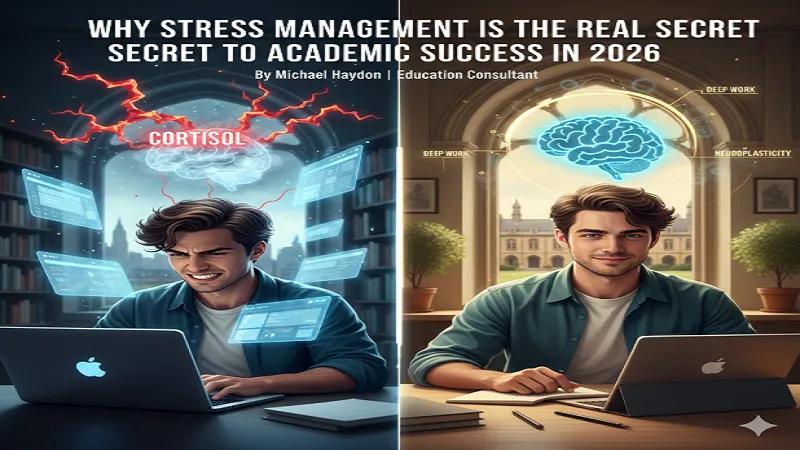
In small, acute bursts, the hormone cortisol is actually beneficial. It provides the “fight or flight” energy needed to power through a final hour of revision. However, 2026 research into student mental health shows that many UK students are living in a state of chronic elevation.
When cortisol levels remain high for weeks, the hormone begins to physically impair the prefrontal cortex. This is the “CEO” of your brain, responsible for executive function and complex problem-solving. Simultaneously, stress overstimulates the amygdala, your brain’s emotional alarm system. This “amygdala hijack” is the scientific reason behind the dreaded “exam room brain-blank.” You haven’t forgotten the facts; your brain has simply prioritized survival over retrieval.
The Fallacy of “Grind Culture” in UK Education
For decades, British education has been shadowed by “grind culture”—the belief that exhaustion is a badge of honor. However, data from the Mental Health Foundation (2025) reveals that 60% of young people in the UK have felt so pressured to succeed that they felt unable to cope.
In 2026, we are seeing a shift toward Cognitive Load Theory. The human brain has a limited “bandwidth” for processing new information. When you attempt to study for 10 hours straight, you hit a point of diminishing returns. After the fourth hour, your ability to retain new data drops by nearly 70%. High-performing students are moving away from the “grind” and toward Evidence-Based Productivity, which prioritizes brain health over total hours clocked.
The 90-Minute “Deep Work” Protocol
One of the most effective study hacks for high school and university students today is the 90-minute Deep Work cycle, based on the body’s natural ultradian rhythms.
- The Phase: Focus intensely on one difficult task (like a complex physics problem or a literature review) for exactly 90 minutes.
- The Reset: Take a 15-to-20-minute break. Crucially, this must be a “digital-free” break. Scrolling through social media does not count as rest; it actually increases “attention residue.”
- The Result: By working in these cycles, you align your study habits with your brain’s metabolic capacity, significantly reducing academic fatigue.
Strategic Outsourcing: Balancing the Academic Load
Even with a perfect biological routine, the sheer volume of modern academic requirements can become mathematically impossible to manage alone. In 2026, recognizing when the workload exceeds human capacity isn’t a sign of weakness—it’s a sign of high Emotional Intelligence (EQ).
Many high-achieving students are adopting a “hybrid” approach to their education. By utilizing professional academic help platforms or working with an experienced assignment helper for expert guidance, structured research, and complex assignment proofing, they create the mental “breathing room” necessary to focus on their primary learning objectives.
This is a strategy used by top executives and researchers globally: delegating the peripheral to focus on the core. Utilizing reputable help services helps mitigate “deadline dread,” ensuring that when a student sits down for an exam, they do so with a calm, regulated nervous system rather than one on the verge of burnout.
Physical Resilience: The Glymphatic System
In the UK, 2026 health reports indicate that nearly 70% of students suffer from disturbed sleep patterns during peak assessment months. We often view sleep as a luxury, but it is a non-negotiable biological requirement.
During deep sleep, the brain’s glymphatic system becomes active. This system literally flushes out metabolic waste—specifically neurotoxic byproducts like beta-amyloid—that build up during the day. Without this “nightly cleaning,” your brain remains “foggy,” making it nearly impossible to grasp complex new concepts.
Cognitive Reframing: Turning Anxiety into Focus
UK sports psychologists have long used a technique called Cognitive Reframing. When you feel your heart racing before a presentation, your instinct is to label it as “anxiety.”
In 2026, students are being taught to relabel this as “readiness.” The physical sensations of anxiety and excitement are nearly identical. By telling yourself, “My body is pumping adrenaline to help me focus,” you prevent the “freeze” response and keep the prefrontal cortex online.
Frequently Asked Questions
Q.1 Does stress physically damage the brain?
Prolonged, unmanaged stress can shrink dendrites in the prefrontal cortex. However, the brain is neuroplastic; by implementing stress-management techniques, you can reverse these effects.
Q.2 Is it “cheating” to use academic help services?
In 2026, the consensus among education consultants is that using professional guidance for research and structure is a valid form of Strategic Time Management, much like a professional using a consultant.
Q.3 How do I stop a “mind blank” during an exam?
The fastest way is “Box Breathing”: inhale for 4 seconds, hold for 4, exhale for 4, and hold for 4. This deactivates the “fight or flight” response. See more